This post contains affiliate links. My website is my job, and helps to support our family. If you decide to buy something you see mentioned here, I would be so thankful if you clicked through my links so I can receive a small commission at no cost to you. Thank you! Please read my full disclosure.
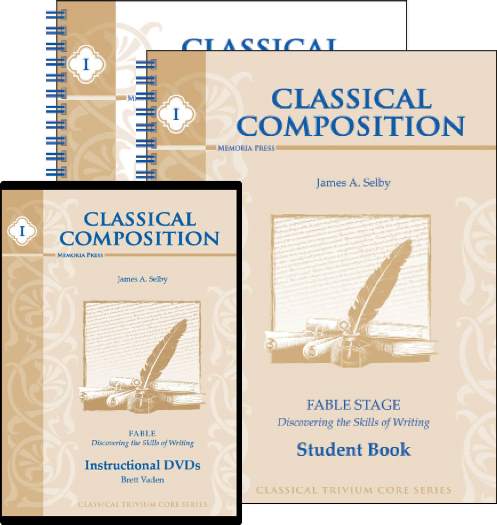
[ctt template=”4″ link=”tiy1l” via=”yes” ]My daughter, Mercedes, was happy to try out Classical Composition I: Fable Set and Classical Composition II: Narrative Set from Memoria Press for a review.[/ctt]
Review of Memoria Press Classical Composition Fable and Narrative
About
Memoria Press is a family publishing company that makes simple and easy-to-use classical Christian curriculum education materials for homeschool and private schools. It was founded by Cheryl Lowe in 1994. What is classical education? Well, modern schools are about two things: progressivism and pragmatism. Progressivism has an emphasis on political correctness and multiculturalism. Pragmatism has an emphasis on job training and employment skills. In classical education, students read the classics. Classical Education has an emphasis on passing on a culture—and one culture in particular: the culture of the Christian West, which includes the study of Athens, Rome, and Jerusalem—the Greeks, the Romans, and the Hebrews cultures.
What We Received
We received all of these products packaged very well with shipping materials in a sturdy box and we received them quickly, well within the expected time. Included in the package were the following:
I just want you to know that Mercedes received an “Accelerated I Lesson Plan book” from Memoria Press to maximize the review period so we could get more done in less time and give a thorough review. She did not mind this as she was looking forward to learning the information. Please keep in mind that the Accelerated Lesson Plan book does not come with the standard kit. If you wish to go through this at an accelerated pace, you need to purchase this in addition to the kit. It comes in both a printed and a digital form.
Mercedes would place a yellow “tabbie” on the day and week she was working on, rather than writing in the book, but as you can see from the photo above, there are boxes to check when you complete a section. She is my third child out of seven and has been taught to save materials for “the next child”. The Teacher Guide (example in photo below) for each subject tells you exactly what to do for each lesson, so it is not necessary to have a Lesson Plan book.
In our home, we worked on this everyday. She would just look in her lesson plan book and see what she had to do for the day and do those things. It may be watching the DVD, reading a new fable for the day, writing answers in the student book, or rewriting the fable. Then for the next fable story, you repeat the same procedure.
Fable Set: Teacher Guide, Student Book and Instructional DVDs
Fable
Let’s talk first about the Instructional DVDs. I was really impressed with these! You get a professional teacher that will teach you everything about each fable, the plot components, variations, and teach you to outline, paraphrase and summarize it. The teacher spoke clearly and enunciated words so that we understood them well.
During the video, the instructor would tell her what to do in the student book and then ask her to pause. She would do that and then play the next section of the video, etc.
Save
Mercedes showing some of her work pages from the Fable set.
She would read the fable aloud. The questions asked really gets the student busy dissecting the story. She would re-read the fable many times to achieve this. She would give examples of three plot components, give some synonyms and variations. She would then outline the story. Then she would paraphrase it using a figure of description, like examples of “anemographia” for example, which is a vivid description of wind; e.g., “a cool breeze tickled its back”.
Save
Mercedes shows another completed work page in the Fable set.
Then she would be asked to rewrite the fable again in a different way, for one example, by reduction, leaving out all the extra detail.
Then she would give synonyms and vary the sentence in another variations section. Then she would learn the next fable and repeat the process through the entire student book in the same way.
Save
Mercedes holds up her completed work pages in the Fable book about The Fox and the Grapes
The teacher guide is very useful for checking the student’s work. It gives example answers and tells what to do in order for each lesson.
Save
Narrative Set: Teacher Guide, Student Book and Instructional DVDs
Narrative
The narrative set also has the Instructional DVDs. They are taught by the same instructor, who is Brett Vaden. He taught at Highlands Latin School and the Memoria Press Online Academy. He is a 2004 graduate of The Moody Bible Institute in Chicago with a degree in Biblical Languages. He is also an editor of Classical Composition for Memoria Press. At Southern Seminary, Brett earned an Advanced M.Div. in Biblical and Theological Studies and a Ph.D. in Pastoral Theology. So he is an educated teacher, for sure!
The Teacher Guide is just like the one for the Fable set. But it has one awesome addition! At the bottom of the page for each Lesson, it includes Teacher Tips! An example of a tip is, “Be flexible with which methods of amplification you use. You don’t need to require each one for every assignment, but make sure you are working toward long-term mastery of each. For me, that is a blessing to have these tips. As a mom of seven, I have a lot going on in the house and in my brain and may not think of that.
The Student Guide has some similarities and differences…
Similar
She watches the Instructional DVD and Mr. Vaden asks her to pause to complete a task.
She reads the story aloud.
She completes an outline.
In Variations: Part I, she still gives two synonyms and varies the sentence in three ways.
Different
Instead of a Fable, she is reading a narrative. Some examples are: Elijah and the Burning Sacrifice, Conrad von Tannenberg, and The Sower.
Instead of three plot components for each story, there are nine and she also needs to identify the “who, what, when, where, how and why”.
In Variations: Part I, she now needs to add two other variations once each per synonym, like hyperbole and diminutio or periphrasis and metaphor, for example.
In Paraphrases, there are now only two figures of description to expand the outline, rather than three, and she is still asked to rewrite it again in a different way, following the suggestion.
In Variations: Part 2, she now needs to add two other variations once each per synonym.
Now there is an additional section, called “Final Draft” and here she is asked to write using special instructions, which change for each narrative.
Mercedes’ Opinion
“It was pretty good, overall. I felt it was very educational. I kind of wish there was more variety. It seemed like I was doing the same thing over with each story. I didn’t feel creative because I was writing based off of what someone else wrote. I personally prefer to write longer stories and these were all quite short, so it would be great to teach a beginning writer or someone who prefers to do less writing for an assignment.”
My Opinion
I feel this is a very thorough writing program to use for a year of homeschooling and I love the teacher book that tells me what to do for each Lesson, in order. I always feel like writing is a difficult thing for me to check over as a teacher, because you can have so many creative variations, it’s kind of like judging Art! I do like that the Teacher Guide has samples to compare to, that helps me so much. I do wish that the first Teacher Guide had the Teacher Tips like the Narrative Teacher Guide does. I think they are very helpful. I do feel that there was enough space to write all of the answers to the questions, so I would not change a thing about the Student Guides.
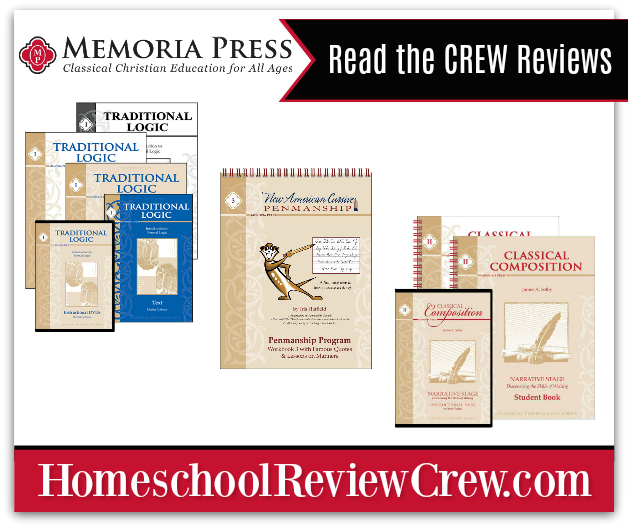
The Old Schoolhouse Homeschool Review Crew has a great team of people that have also used and reviewed these books as well as others (including New American Cursive and Traditional Logic) from Memoria Press, so click the banner below to see all the reviews:
Subscribe to receive our latest articles and promotional content by email from NeededInTheHome
Your request has been received and information has been sent to you.
Please check your email!
IMPORTANT! To make sure that our mail reaches your inbox correctly and is not blocked by mistake, please add our email address to your whitelist - amy@neededinthehome.com to your email address book and/or to "whitelist" (trusted senders).







Leave a Reply